
What is ALARP?
ALARP stands for As Low As Reasonably Practicable. It forms part of the overall tolerability-of-risk framework described by the HSE, and it is a cornerstone principle for making safety decisions you can defend.
At its heart, ALARP is about proportion. It requires organisations to take every reasonable and practical step to reduce a risk — but stops short of demanding measures whose cost, time, or effort would be grossly disproportionate to the reduction in risk they achieve. In other words, ALARP is not a demand to eliminate all risk; it is a test of when you have done enough.
The Tolerability of Risk Triangle
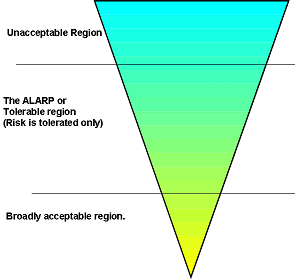
ALARP is most often pictured as a triangle, widest at the top and narrowing to a point at the bottom. Risk increases as you move up the triangle, and it divides into three regions.
- Unacceptable region (top). Here the risk is regarded as too high whatever the benefits. An activity falling into this region would normally be ruled out unless something can be done to move it down into one of the regions below.
- Tolerable region (middle). This is the ALARP zone. Risk here is only acceptable if it has been reduced as far as is reasonably practicable — it is tolerated, not welcomed, and only on the condition that it is properly controlled.
- Broadly acceptable region (bottom). Risks here are regarded as insignificant and adequately controlled. No further action is normally required, though obvious and practicable improvements should still be adopted.
The Objective of ALARP
The objective of ALARP can be stated in two parts:
- Reducing a risk to a level that is as low as reasonably practicable means balancing the reduction in risk against the time, trouble, difficulty, and cost of achieving it.
- That level is the point — assessed objectively — at which the time, trouble, difficulty, and cost of any further reduction would be unreasonably disproportionate to the additional risk reduction it would buy.
How ALARP Works
In practice, ALARP rests on weighing two things against each other:
- The level of risk – how likely the harm is, and how severe.
- The resources needed to reduce it – the time, cost, and effort further controls would demand.
To satisfy the principle, an organisation must be able to show that:
- Every realistic measure to reduce the risk has been considered, and
- Any risk that remains is justified, because reducing it further would not be reasonably practicable.
How is ALARP Demonstrated?
Because ALARP turns on proportion, demonstrating it requires a genuine cost-versus-benefit analysis rather than an assertion. BowTie Pro™ supports this by letting controls be categorised against many attributes, including their cost and their benefit.
In simple terms, a good ALARP demonstration should identify both what more could be done — the additional measures that could be put in place — and why those measures are not necessary. Working this through will typically:
- Require information on which processes are operated remotely, and on the reasoning behind remote versus non-remote operation.
- Require information on the controls already in place, including relevant good practice from HSE guidance, recognised standards, and industry practice, which together indicate the minimum compliance standard.
- For risks in the tolerable-if-ALARP region, require a detailed look at the control measures and a rigorous demonstration that every reasonably practicable measure has been taken. When no further reasonably practicable reduction can be identified, the residual risk is ALARP.
- For risks in the broadly acceptable region, require a demonstration based on adopting relevant good practice, engineering standards, and recognised codes, with any obvious and practicable improvements still introduced.
Determining That Risk Has Been Reduced ALARP
How much rigour this demonstration needs varies with the situation — the nature of the hazard, the extent of the risk, and the control measures involved. A more systematic approach is more rigorous and more transparent to a regulator and other interested parties. At the same time, duty-holders and regulators alike should not be overburdened where that level of rigour isn’t warranted. The guiding rule of thumb: the greater the initial level of risk, the greater the degree of rigour expected of the arguments used to show that it has been reduced ALARP.
Why ALARP Matters
- It helps organisations make balanced, defensible safety decisions, rather than arbitrary ones.
- It ensures resources are directed where they do the most good, instead of being spent chasing negligible gains.
- It underpins regulatory compliance and safety case requirements, which frequently expect an explicit ALARP argument.
- It provides clear evidence that risks are being actively managed, not simply accepted.
Summary
ALARP is not about eliminating every risk — it is about reducing risk to a sensible, justifiable level, and being able to prove you have done so. By mapping risks against the tolerability triangle, weighing reduction against the effort it demands, and documenting both what more could be done and why it isn’t warranted, organisations can show that safety improvements have been made wherever they are reasonable and practical — and stop, with confidence, at the point where they aren’t.